

Developer: Ripknot Systems



At a glance
75 Steam reviews rate it “Mixed” (67% positive). Released on July 16, 2017 by Ripknot Systems. Current price: $0.99.
Description
Features:
20 Unique Levels
Randomized Puzzles Every Game(no play through is exactly the same)
Timed Rounds
Collect stars each round to keep track of how your doing
Supported languages: english
Something wrong on this page? Let us know
Description and screenshots are provided by the publisher via the Steam Store page.
System Requirements
Windows
- OS *: Win 7 +
- Processor: Intel Core i5 +
- Memory: 1 GB RAM
- Graphics: Nvidia GTX 1GB VRA
- DirectX: Version 9.0
- Storage: 400 MB available space
User Reviews
+ 5000 Achievements
An asset flip wordsearch. Buggy!
👍

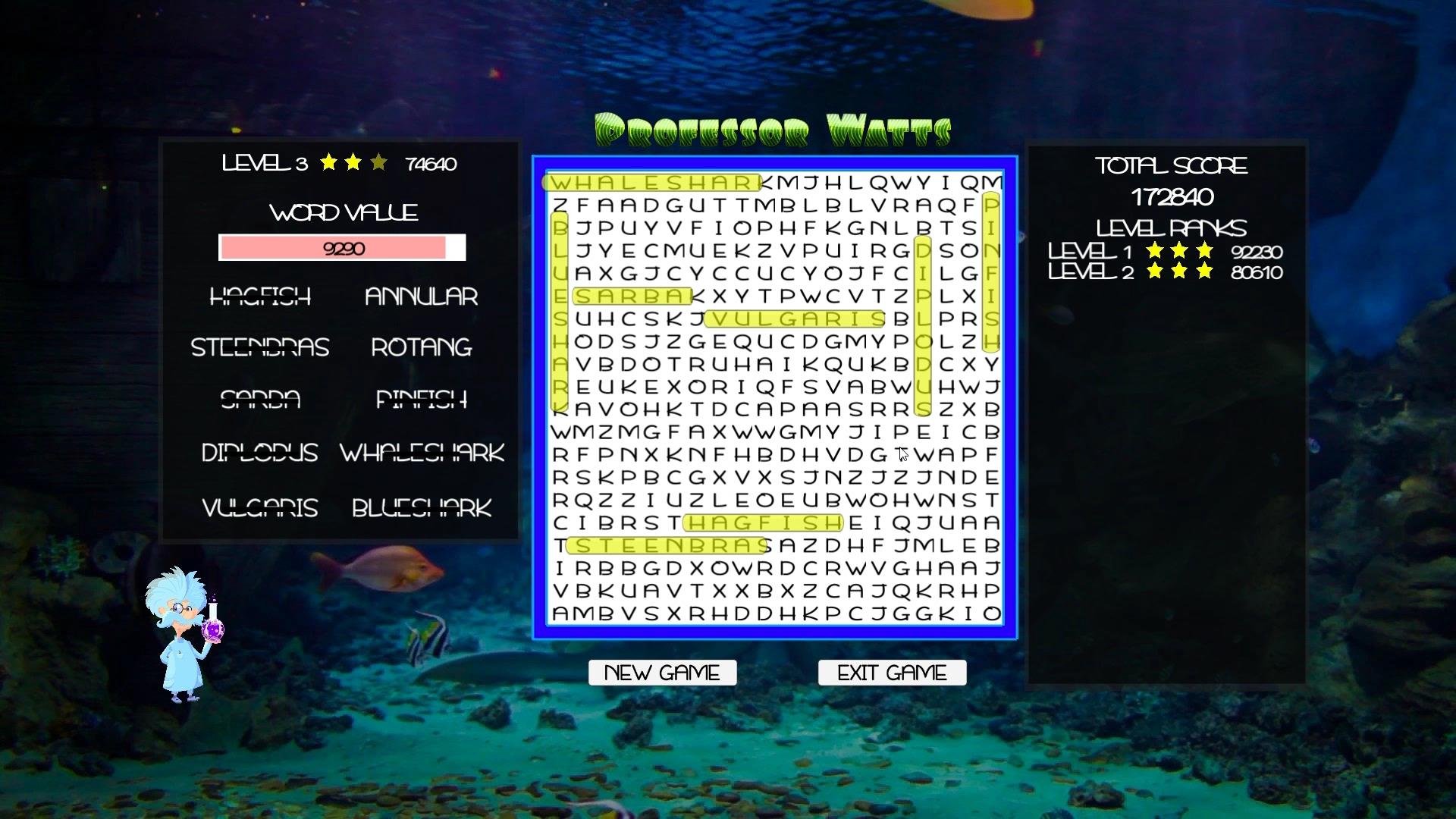
Professor Watts Word Search: Into the Ocean is a compact, straightforward puzzle title from Ripknot Systems that aims squarely at casual players who enjoy classic word-search gameplay without added complexity or narrative demands. It is part of a small series built around the eccentric Professor Watts, though the framing story here is little more than a light justification for the puzzles: the professor returns from an ocean expedition to find his research scrambled, and you, the player, must reorganize the information by completing themed word-searches. The premise is thin, but by design—it merely sets the stage for a series of relaxed, bite-sized sessions focused entirely on scanning grids, identifying words, and pushing toward better times or higher rankings.
At its core, the game offers about twenty levels, each of which generates randomized letter grids whenever you replay them. This is perhaps its most meaningful source of replayability. Even though the word lists remain the same, the shifting letter layouts ensure that no two puzzle runs are identical. For fans of traditional word-search books or mobile puzzle apps, this makes the game feel familiar but not monotonous. The addition of a timed mode and a three-star ranking system gives players a small but consistent sense of progression, inviting them to refine their pattern recognition and complete puzzles more efficiently. With its easy controls, short completion time per level, and immediate rhythm of “scan, find, highlight,” the game fits neatly into the niche of low-pressure, accessible mental challenges.
The presentation is clean and uncomplicated. The UI is minimal, focusing almost entirely on the puzzle grid and the word list. Artwork and animations are sparse, but the game does not pretend otherwise; its objective is functionality. The theming—centered around ocean concepts and research—is light and mostly cosmetic, appearing in level titles, background designs, and the word lists themselves. The low system requirements, small install size, and snappy loading times make it a game that almost any machine can run effortlessly. This accessibility is one of its quiet strengths: it is a game anyone can pick up instantly without tutorials, confusion, or mechanical hurdles.
However, the narrow scope is also where the game begins to reveal its limitations. Because Professor Watts Word Search revolves entirely around one mechanic, the experience can lose its appeal rather quickly for players who are not deeply invested in traditional word puzzles. Even with randomized grids, the formula remains essentially unchanged after the first few levels, and the difficulty curve is shallow. The puzzles do not introduce new twists, mechanics, or constraints, nor do later stages push the player to develop new strategies or patterns of play. This sameness makes the game best suited for short sessions rather than extended play, as longer periods tend to amplify the sense of repetition.
Additionally, the game’s story elements are barely present, offering no emotional stakes, character development, or narrative rewards. For some players, especially those who prefer puzzle games with charming characters or connective arcs, the minimal storytelling may feel like a missed opportunity. The overall production values—including static visuals, simple sound design, and basic transitions—reinforce the impression of a lightweight puzzle package rather than a fully realized adventure. None of these elements impede functionality, but they do limit immersion and artistic identity.
The reception to the game reflects this divide. Many players appreciate it for what it is: a simple, inexpensive word-search game that delivers straightforward enjoyment in small doses. Others criticize the lack of variety, the brevity of the content, or the absence of meaningful innovations compared to free browser-based puzzle offerings. In this respect, the game’s value largely depends on individual expectations. Those seeking a calm, relaxing diversion will likely find it pleasant enough, while those hoping for something more substantial—whether in story, presentation, or mechanical evolution—may walk away feeling underwhelmed.
Ultimately, Professor Watts Word Search: Into the Ocean fulfills its purpose as a casual, low-stakes puzzle experience anchored in classic word-search mechanics. It is easy to play, approachable for all ages, and designed for moments when the player wants to unwind without thinking too hard or committing to lengthy gameplay. It does not attempt to redefine the puzzle genre, and it does not offer depth beyond its core gimmick, but for devotees of word searches and those who enjoy brief mental exercises, it serves as a comfortable, lightweight companion.
Rating: 5/10
easy achievements what can I say :D I don't understand why people are mad, it's like they "don't" know that the game is only for achievements I think that's obvious? 10/10 anyways
Games similar to Professor Watts Word Search: Into The Ocean




Additional Information
| Developer | Ripknot Systems |
| Platforms | Windows |
| Age rating | None |
| Release date | July 16, 2017 |
| User reviews | 67% positive (75) |
