
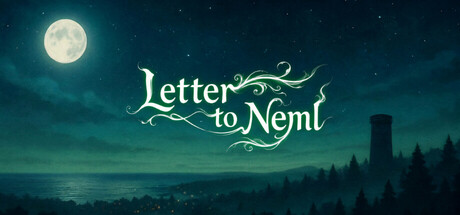
Developer: Laineus


At a glance
18 Steam reviews rate it “Positive” (83% positive). Released on February 22, 2026 by Laineus. It is free to play.
Description
Genre: Short Narrative Adventure
Estimated Play Time: ~1 hour
Story
A story about the Noctarian, a race whose nightmares become reality.
Two girls, Neml and Nina, live quietly together.
One day, Nina is forced to leave home on urgent business, leaving Neml behind with a single letter.
While staying home alone, Neml encounters a series of unexpected troubles.
Shy and unfamiliar with the outside world, the only thing Neml can rely on
are the words written in the letter Nina left behind.
The choices she makes by following that letter will eventually shape not only her own fate,
but the future of the world itself.
System
The player can perform only one action.
Rewrite the contents of the letter left for Neml.
Using character dialogue, highlighted key lines,
and objects or situations shown in the background as clues,
the player freely writes what should be conveyed to Neml in plain text.
An AI interprets the contents of the letter, altering Neml’s actions, decisions,
and the direction of the story.
At times, Neml may lose her life and the story will rewind to the beginning.
By rewriting the letter each time, the player can avoid past mistakes and reach different endings.
Supported languages: english, japanese, simplified chinese
Something wrong on this page? Let us know
Description and screenshots are provided by the publisher via the Steam Store page.
System Requirements
Windows
- OS: Windows11
- Processor: 2+ GHz processor
- Memory: 4 MB RAM
- Storage: 350 MB available space
Mac
- OS: Mac OSX
- Processor: 2+ GHz processor
- Memory: 4 MB RAM
- Storage: 283 MB available space
Linux
- OS: Linux
- Processor: 2+ GHz processor
- Memory: 4 MB RAM
- Storage: 305 MB available space
User Reviews

Letter to Neml is an imaginative narrative adventure that turns the simple act of writing a letter into an unusual form of interactive storytelling. Developed and published by Laineus, this free-to-play indie experience combines psychological tension, supernatural fantasy, and artificial intelligence to create a game where communication carries potentially devastating consequences. Instead of controlling a character through traditional movement commands or selecting predetermined dialogue options, players influence events by rewriting instructions intended for a vulnerable young girl. The concept is refreshingly unconventional, offering an intimate experience that emphasizes observation, careful reasoning, and the importance of choosing words wisely.
The story unfolds in a mysterious world inhabited by the Noctarian, beings whose nightmares possess the frightening ability to become reality. Within this unsettling environment, two girls named Nina and Neml share a peaceful existence until circumstances force Nina to leave unexpectedly. Concerned about Neml's safety, Nina prepares a letter containing guidance to help her navigate unfamiliar situations. Unfortunately, Neml is inexperienced, timid, and poorly equipped to recognize the dangers surrounding her. As supernatural events begin threatening her safety, the letter becomes her most important connection to someone she trusts. What begins as a personal story about separation and protection gradually develops into a disturbing adventure where seemingly minor decisions can produce catastrophic outcomes.
The defining feature of the gameplay is its reliance on indirect control. Players cannot simply order Neml to move somewhere, interact with an object, or escape danger through conventional commands. Instead, they must examine the information presented, understand the circumstances, and modify the contents of Nina's letter. This creates a distinctive relationship between the player and the protagonist because success depends on whether written guidance communicates the intended message effectively. The mechanic encourages thoughtful participation rather than reflexes, making every sentence potentially meaningful. Players must pay attention to dialogue, environmental clues, and highlighted information to determine which instructions might help Neml survive.
Artificial intelligence adds another dimension to this experimental structure. Using technology connected to Google's Gemini API, the game interprets freely written instructions and incorporates their meaning into narrative progression. This allows players to approach situations without being restricted to a small collection of predetermined responses. The freedom to formulate personal solutions makes the experience feel more expressive than a conventional visual novel. However, the technology also introduces uncertainty. Instructions that appear perfectly reasonable to a human reader may not always produce the expected interpretation. This unpredictability can encourage experimentation, but it may occasionally undermine the satisfaction of solving a problem through careful reasoning.
Failure is incorporated into the experience through a repeating narrative structure. When Neml encounters a fatal outcome, events return to the beginning, giving players another opportunity to reconsider their previous instructions. This creates a process of observation, experimentation, and correction, where unsuccessful attempts can provide valuable knowledge about the world. Rather than relying on traditional combat encounters or increasingly difficult mechanical challenges, progression comes from understanding how particular words influence behavior. The system is especially effective when a disastrous outcome reveals an overlooked detail or demonstrates why an earlier instruction was insufficient. Nevertheless, repeatedly revisiting familiar situations may become tedious, particularly when players struggle to identify why their chosen wording failed.
The emotional impact comes primarily from Neml's vulnerability and her dependence on Nina's guidance. Unlike adventures where protagonists possess considerable independence, this story emphasizes the responsibilities associated with influencing another person's decisions. The player occupies an unusual position, simultaneously acting as a protector and a potential source of danger. Even well-intentioned instructions can produce unintended consequences, reinforcing the idea that communication requires understanding rather than simply issuing commands. The supernatural premise strengthens these themes by placing ordinary emotional concerns within an increasingly threatening environment. Beneath its experimental mechanics, the game explores trust, separation, responsibility, and the consequences of misunderstanding.
Visually, Letter to Neml favors a restrained two-dimensional presentation suited to its narrative-driven design. Character interactions, written information, and environmental details receive greater attention than elaborate action sequences. Its visual-novel influences are apparent, although the interactive letter system gives it a separate identity. The mysterious atmosphere complements the psychological horror elements, creating tension through uncertainty rather than depending entirely on sudden scares. Certain graphical and musical assets were created using generative artificial intelligence, an artistic decision that fits the technological experimentation behind the gameplay. While this approach may not appeal to everyone, the presentation supports the game's focus on storytelling and atmosphere.
The relatively short experience is both an advantage and a limitation. An initial playthrough is estimated to last around an hour, making it accessible to players who prefer concentrated narrative adventures. Multiple endings encourage experimentation, while eight Steam achievements provide additional objectives for completionists. Steam Cloud functionality and support for Windows, macOS, and Linux add practical convenience. However, the limited duration and narrow gameplay structure may disappoint players expecting extensive exploration, complex puzzles, or substantial character development. The external AI integration also creates potential concerns regarding consistent interpretation and connectivity.
Steam Deck compatibility remains officially Unknown or Unverified, with no confirmed Verified or Playable designation. Although Linux support is listed, this does not automatically guarantee smooth operation on Valve's handheld. The extensive reading and frequent text entry may require the virtual keyboard, making interaction less convenient than on a desktop computer. The game's dependence on AI-powered text interpretation may also require an active internet connection. Players interested in experiencing it on Steam Deck should therefore approach compatibility cautiously until reliable testing becomes available.
Overall, Letter to Neml succeeds as an inventive experiment in interactive storytelling, demonstrating how written language can become the foundation of an engaging adventure. Its supernatural setting, emotionally vulnerable protagonist, and unconventional decision-making mechanics distinguish it from more traditional narrative games. Although occasional AI interpretation problems, repetitive attempts, and limited content may reduce its appeal, the central concept remains compelling. Its free-to-play accessibility makes it particularly attractive to players interested in unusual indie projects that prioritize creativity over mechanical complexity. For those willing to embrace its experimental nature, it offers a memorable exploration of how words can shape another person's fate.
Rating: 7/10
Letter to Neml is a really unusual little story game because the main thing I actually do is rewrite a letter. I am not controlling Neml directly or picking from a normal list of dialogue choices. Instead, Nina leaves her a letter before going away, and I can change what that letter tells Neml to do. Neml is shy and not used to being outside on her own, so the advice in the letter can make a huge difference to what happens next. I like how simple the idea is because it gives the whole game a very different kind of interaction.
The setting is also much stranger than it first appears. Neml and Nina are part of the Noctarian race, whose nightmares can become real, and the story slowly builds around that idea. Neml starts running into unexpected problems while she is alone, and I have to use dialogue, important lines and things happening in the background as clues when deciding what to write. I like that I am not simply choosing between good and bad options. I actually have to think about what advice might help Neml in the situation she is facing.
The most interesting part for me is the AI system. What I write into the letter is interpreted by AI, which then changes Neml's actions and the direction of the story. That makes the game feel more experimental than a normal visual novel because I am not limited to a few prepared answers. I can phrase my advice in my own way and see what happens. When Neml dies, the story rewinds and I can rewrite the letter with what I have learned. That gives the short game a nice trial and error structure.
The biggest problem is also the AI system. Because the game is interpreting what I write rather than simply checking a fixed answer, I sometimes feel like I am trying to work out what the game expects instead of naturally giving Neml advice. The idea is clever, but it means the outcome can feel less predictable than a traditional choice based story. I think that is interesting for a while, although I can see it becoming frustrating if I keep trying to get a particular ending and the system does not understand exactly what I mean.
The game is also very short, with the developer estimating around an hour for a playthrough. That is not necessarily a bad thing because the whole concept is designed around replaying the story and finding different endings, but the first playthrough can feel like it ends just as I am getting properly invested. The multiple endings give me a reason to go back and change my letter, and I like seeing how small changes can completely alter what happens. Still, I would have liked a little more story and character development between some of the major events.
I also appreciate that Letter to Neml is completely free. It does not need a big progression system or loads of content because the main attraction is experimenting with the letter and seeing how the story reacts. The presentation is simple, but the strange atmosphere and darker moments fit the story well. There is also some AI generated artwork and music, which makes sense considering how heavily the game is built around AI, although I think the concept itself is much more interesting to me than the presentation.
Overall, Letter to Neml is a creative experiment that I think is worth trying because it does something genuinely different with interactive storytelling. I like the idea of controlling the story through a letter, using clues to decide what advice to give Neml and then seeing an AI interpret my choices. The short length and occasional unpredictability stop it from being one of my highest rated narrative games, but the concept is clever enough to make it memorable. Since it is free, I think it is well worth spending an hour with, especially if I want something that feels different from a normal visual novel or adventure game.
Rating: 7.2/10
I wrote a ton of different things, it didn't seem to change anything. Neat concept though.
As much as I didn't want to give a yuri game a negative review, but this is just so bad. This is just a lazy abomination of VN made with AI slop. You could just make this with good old 'if-else', you didn't need to implement Gemini AI or something for this VN to work.

⢸⠉⠉⠉⠉⠉⠉⠉⠉⠉⠉⠉⠉⠉⡷⡄⠀⠀⠀⠀⠀⠀⠀⠀⠀⠀⠀⠀⠀
⢸⠀⠀⠀⠀⠀⠀⠀⠀⠀⠀⠀⠀⠀⠀⠀⠀⡇⠢⣀⠀⠀⠀⠀⠀⠀⠀⠀⠀⠀⠀
⢸⠀⠀⠀⠀⠀⠀⠀⠀⠀⠀⠀⠀⠀⠀⠀⠀⡇⠀⠀⠈⠑⢦⡀⠀⠀⠀⠀⠀Are you crying son?
⢸⠀⠀⠀⠀⢀⠖⠒⠒⠒⢤⠀⠀⠀⠀⠀⡇⠀⠀⠀⠀⠀⠙⢦⡀⠀⠀⠀⠀
⢸⠀⠀⣀⢤⣼⣀⡠⠤⠤⠼⠤⡄⠀⠀⡇⠀⠀⠀⠀⠀⠀⠀⠙⢄⠀⠀⠀⠀
⢸⠀⠀⠑⡤⠤⡒⠒⠒⡊⠙⡏⠀⢀⠀⡇⠀⠀⠀⠀⠀⠀⠀⠀⠀⠑⠢⡄⠀
⢸⠀⠀⠀⠇⠀⣀⣀⣀⣀⢀⠧⠟⠁⠀⡇⠀⠀⠀⠀⠀⠀⠀⠀⠀⠀⠀⡇⠀
⢸⠀⠀⠀⠸⣀⠀⠀⠈⢉⠟⠓⠀⠀⠀⠀⡇⠀⠀⠀⠀⠀⠀⠀⠀⠀⠀⠀⢸
⢸⠀⠀⠀⠀⠈⢱⡖⠋⠁⠀⠀⠀⠀⠀⠀⡇⠀⠀⠀⠀⠀⠀⠀⠀⠀⠀⠀⢸
⢸⠀⠀⠀⠀⣠⢺⠧⢄⣀⠀⠀⣀⣀⠀⠀⡇⠀⠀⠀⠀⠀⠀⠀⠀⠀⠀⠀⢸
⢸⠀⠀⠀⣠⠃⢸⠀⠀⠈⠉⡽⠿⠯⡆⠀⡇⠀⠀⠀⠀⠀⠀⠀⠀⠀⠀⠀⢸
⢸⠀⠀⣰⠁⠀⢸⠀⠀⠀⠀⠉⠉⠉⠀⠀⡇⠀⠀⠀⠀⠀⠀⠀⠀⠀⠀⠀⢸
⢸⠀⠀⠣⠀⠀⢸⢄⠀⠀⠀⠀⠀⠀⠀⠀⠀⡇⠀⠀⠀⠀⠀⠀⠀⠀⠀⠀⢸
⢸⠀⠀⠀⠀⠀⢸⠀⢇⠀⠀⠀⠀⠀⠀⠀⠀⡇⠀⠀⠀⠀⠀⠀⠀⠀⠀⠀⢸
⢸⠀⠀⠀⠀⠀⡌⠀⠈⡆⠀⠀⠀⠀⠀⠀⠀⡇⠀⠀⠀⠀⠀⠀⠀⠀⠀⠀⢸
⢸⠀⠀⠀⠀⢠⠃⠀⠀⡇⠀⠀⠀⠀⠀⠀⠀⡇⠀⠀⠀⠀⠀⠀⠀⠀⠀⠀⢸
⢸⠀⠀⠀⠀⢸⠀⠀⠀⠁⠀⠀⠀⠀⠀⠀⠀⠷


Additional Information
| Developer | Laineus |
| Platforms | Windows, Mac, Linux |
| Age rating | None |
| Release date | February 22, 2026 |
| User reviews | 83% positive (18) |