
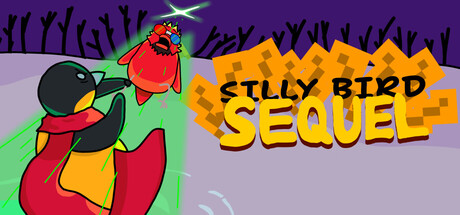
Developer: no Entertainment


At a glance
1 Steam reviews rate it “Not enough reviews” (100% positive). Released on February 12, 2026 by no Entertainment. Current price: $2.99.
Description
Silly Bird Sequel is a fast-paced precision 2D platformer.
Your friend Jared has been kidnapped by a light from the sky. You never really liked him much, but you've got nothing better to do, so you should probably go rescue him. Be prepared to meet a cast of bird-brained characters and witness a goofy, pun-filled story unfold before your eyes!
Collect various Upgrades that synergize with each other to open up countless movement opportunities. You might start out as a little fledgeling, but you'll be Sliding, Diving and Dashing over obstacles in no time!
If you yearn for difficulty, the game will teach you some high-level movement tech, requiring complex inputs and precise timing and allowing you to take full advantage of the environment. Use the knowledge you gained to conquer the optional ultimate challenge! And with mastery comes great speed.
Supported languages: english, russian
Something wrong on this page? Let us know
Description and screenshots are provided by the publisher via the Steam Store page.
System Requirements
Windows
- Requires a 64-bit processor and operating system
- OS: Windows 10
- Processor: Intel Core i3-8130U
- Memory: 4 GB RAM
- Graphics: Intel UHD Graphics 620
- DirectX: Version 12
- Storage: 200 MB available space
- Additional Notes: Doesn't perform as well as you'd expect, my bad
- Requires a 64-bit processor and operating system
- OS: Windows 11
- Processor: Intel Core i5-6600K, AMD Ryzen 5 1600
- Memory: 8 GB RAM
- Graphics: NVIDIA GeForce GTX1050, AMD Radeon RX 460
- DirectX: Version 12
- Storage: 200 MB available space
Mac
Linux
- OS: Linux distribution released after 2018
- Processor: Intel Core i3-8130U
- Memory: 4 GB RAM
- Graphics: Intel UHD Graphics 620
- Storage: 200 MB available space
- Additional Notes: Doesn't perform as well as you'd expect, my bad
- OS: Linux distribution released after 2020
- Processor: Intel Core i5-6600K, AMD Ryzen 5 1600
- Memory: 8 GB RAM
- Graphics: NVIDIA GeForce GTX1050, AMD Radeon RX 460
- Storage: 200 MB available space
User Reviews

Silly Bird Sequel, developed and published by no Entertainment, is a deceptively layered 2D platformer that disguises its mechanical depth behind a deliberately goofy exterior. At first glance, it looks like a light, almost throwaway indie title built around a cartoonish bird and a nonsensical premise, but the longer you spend with it, the more it reveals itself as a carefully constructed precision platformer that values mastery, experimentation, and player improvement over accessibility and hand-holding.
The narrative leans fully into absurdity, following a reluctant avian protagonist who sets off on a rescue mission for a kidnapped acquaintance he doesn’t even particularly like. This intentionally unserious setup establishes the tone early, allowing the game to embrace humor, sarcasm, and playful writing without the burden of emotional weight. Dialogue and environmental details often feel tongue-in-cheek, giving the experience a personality that helps offset the inevitable frustration that comes with repeated failure. It’s not a story meant to be analyzed deeply, but it succeeds in keeping the journey entertaining and self-aware.
Where the game truly distinguishes itself is in its movement system. What begins as straightforward platforming gradually evolves into something far more intricate as players unlock new abilities and learn how to combine them. Mechanics such as dashing, diving, sliding, and momentum-based traversal aren’t just optional tools—they become essential components of progression. The real satisfaction comes from chaining these abilities together in fluid sequences, turning what initially feels clunky into something precise and expressive. Over time, the controls begin to feel less like inputs and more like a language that players learn to speak.
Level design plays a critical role in showcasing these mechanics. The world is structured in a semi-open way, encouraging exploration and giving players the freedom to tackle challenges at their own pace. Each new area introduces variations on movement and obstacle design, ensuring that the gameplay continues to evolve rather than stagnate. Optional routes and more demanding platforming sections provide additional layers of challenge, rewarding players who are willing to push their skills further. These segments often feel intentionally crafted to test mastery rather than simply extend playtime, which adds a sense of purpose to the difficulty.
That difficulty, however, is not insignificant. The game expects precision, quick reactions, and a willingness to learn through repetition. Mistakes are common, especially in later stages where timing windows become tighter and sequences more complex. While the mechanics themselves are consistent and fair, the lack of extensive guidance for advanced techniques can make the learning curve feel steep. Players who enjoy honing their skills through trial and error will likely find this rewarding, but those looking for a more forgiving or guided experience may find it demanding to the point of frustration.
Visually, the game adopts a colorful pixel art style that complements its comedic tone. Characters are expressive, environments are lively, and animations carry a sense of exaggerated charm that reinforces the game’s personality. While it doesn’t push technical boundaries, the art direction is cohesive and effective, ensuring that the visuals remain engaging without distracting from gameplay. The overall presentation reflects its indie nature, with occasional rough edges, but these rarely detract from the experience in a meaningful way.
The audio design follows a similar philosophy, offering upbeat and playful tracks that support the pacing of the game without dominating it. Sound effects are responsive and clear, providing useful feedback during movement and interactions. While the soundtrack may not leave a lasting impression on its own, it works well within the context of the game, maintaining energy and reinforcing its lighthearted atmosphere.
One of the more interesting aspects of Silly Bird Sequel is how it balances its approachable aesthetic with its demanding mechanics. It invites players in with humor and simplicity, then gradually reveals a much deeper system that rewards dedication and practice. This contrast can be both a strength and a weakness. For some, it creates a satisfying sense of growth as they improve, while for others, it may feel like a mismatch between expectation and reality.
In the end, Silly Bird Sequel is a game that thrives on its mechanics and personality rather than scope or polish. It doesn’t attempt to be expansive or feature-heavy, but instead focuses on delivering a tight, skill-based experience that encourages players to refine their abilities over time. Its charm, combined with its demanding gameplay, makes it a memorable entry in the indie platformer space, even if it isn’t universally accessible.
Rating: 6/10
Games similar to Silly Bird Sequel


Additional Information
| Developer | no Entertainment |
| Platforms | Windows, Linux |
| Age rating | None |
| Release date | February 12, 2026 |
| User reviews | 100% positive (1) |