
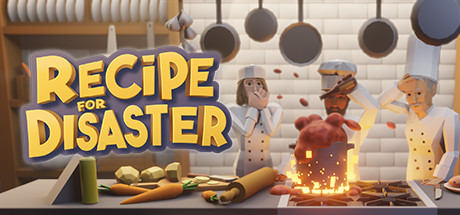
Developer: Dapper Penguin Studios


Player Statistics
Updated: November 8, 2026 6:16 PMAverage players
Players Online
Recipe for Disaster player count by month
Recipe for Disaster has 1 players in-game right now, and the 24-hour peak is 3. The peak so far in November 2026 is 4 players, 2 on average.
| Month | Average players | Change | Peak players |
|---|---|---|---|
| November 2026 (so far) | 2 | — | 4 |
From SteamStat's own samples of the Steam player count since tracking began. Change compares a month's average with the month before.
At a glance
Recipe for Disaster has 1 players in-game right now, 33% of its 24-hour peak of 3. The record since SteamStat started tracking it is 4 players, set on November 7, 2026. 591 Steam reviews rate it “Mixed” (70% positive). Released on August 5, 2022 by Dapper Penguin Studios. Current price: $3.74.
Description
JOIN OUR DISCORD SERVER
ALSO BY THE PUBLISHER
ALSO BY THE DEVELOPER
About the Game
Recipe for Disaster is a management game that challenges you to create and run a highly successful restaurant. Whether turning around the fortunes of failing establishments in pre-set scenarios, or bringing your own vision to life in freeplay mode, you’ll be carefully designing restaurants, hiring and managing the right staff, customizing food menus, and experimenting with ingredients to invent tasty new dishes that will impress your customers. Sounds idyllic, right? Wrong.Blazing a trail through the hectic and stress-inducing world of the food-service industry will be anything but straightforward. After all, this is an industry built around people, and keeping everyone happy, motivated and fulfilled will require nothing short of a miracle! Serious personality flaws and major skill gaps within your team could really disrupt the flow of service, while the volatile attitudes and peculiar tastes of your customers may prove to be the barrier that separates you from those all-important positive review scores.
With perseverance, savvy management and a great deal of compromise, your restaurant will grow, opening up new opportunities and challenges as you attract ever more customers, health inspectors and food critics through your doors. Expand your premises, improve your staff, and walk the precarious line between gastronomic glory and restaurant ruin.
Pick from a pool of procedurally generated hopefuls. Consider each individual’s unique combination of traits and skill levels, and how these might affect their work efficiencies, behaviour and customer interactions. Will they excel? Or will they prove to be more trouble than they’re worth? Manage your team’s mood and stamina levels to minimize the risk of breakdowns and mid-service walkouts. Some staff will love the tasks that you give them, while others will loathe them!
Customize the design and layout of your restaurants using intuitive building tools. Equip your kitchen with state-of-the-art appliances, decorate your dining area, landscape your surroundings, and build storage to hold those precious ingredients.
Manually assign tasks to your team or keep everyone busy using a highly customisable priority system. Keep a close eye on incoming customer orders and adjust your strategy in real-time to ensure the highest standard of food and customer service.
Pay close attention to the demands of your customers and adjust your menu to match their tastes. Be wary of dietary requirements, food allergies and unusual preferences. Decide how best to deal with the requests and complaints of your staff and customers. Will you be sympathetic or combative? Pushovers and tyrants will soon find themselves out of business, so you’ll have to read each situation carefully.
Use the powerful recipe editor to freely create original recipes and add them to your menus. Ensure you have the necessary ingredients by keeping on top of your storage levels and placing regular orders with your suppliers.
Supported languages: english, french, german, spanish - spain, russian, simplified chinese, japanese
Something wrong on this page? Let us know
Description and screenshots are provided by the publisher via the Steam Store page.
System Requirements
Windows
- Requires a 64-bit processor and operating system
- OS: Windows 10
- Processor: Intel i5-4690 / AMD FX 4350
- Memory: 8 GB RAM
- Graphics: Nvidia GTX 780 / AMD Radeon R9 280X
- DirectX: Version 11
- Storage: 2 GB available space
- Additional Notes: Default API is Vulkan 1.1. Directx11 API is provided.
- Requires a 64-bit processor and operating system
- OS: Windows 10
- Processor: Intel i7 4770k / AMD Ryzen 5 1500x
- Memory: 16 GB RAM
- Graphics: Nvidia GTX 1060 6GB / AMD RX580
- DirectX: Version 11
- Storage: 2 GB available space
- Additional Notes: Default API is Vulkan 1.1. Directx11 API is provided.
Mac
Linux
User Reviews
fun, addicting
Don't get me wrong, I really enjoyed this game in the beginning. However, as you progress further (and it doesn't take long) you start running into the same things over and over again.
The game itself has a great concept and a lot of potential, but unfortunately, it seems like the developers have stopped working on it. It was fun for a few hours, but since it doesn't look like anything is going to change or improve in the future, I can't help but feel that it's ultimately an unfinished game.

Recipe for Disaster takes the familiar restaurant-management formula and gives it a stronger emphasis on people, personalities, and the unpredictable problems that emerge when a supposedly efficient business is staffed and visited by individuals with different expectations. Developed by Dapper Penguin Studios and published by Kasedo Games, it combines management, simulation, building, resource planning, and light social mechanics into an experience where designing an attractive restaurant is only the beginning. The real challenge comes from making that restaurant function when employees become exhausted, customers become impatient, ingredients run short, and several problems demand attention simultaneously.
The game provides both structured scenarios and a freeplay option. The scenarios revolve around improving struggling establishments and provide clearer objectives for players who prefer progression with defined goals. Freeplay is better suited to experimentation, allowing greater freedom to develop a restaurant according to personal preferences. Both approaches revolve around the same interconnected systems: designing the establishment, recruiting employees, assigning responsibilities, managing inventory, constructing menus, satisfying customers, and gradually improving the business. The combination works because these mechanics rarely exist independently. A poor kitchen layout can slow employees, delayed service can upset customers, dissatisfied customers can damage the restaurant's reputation, and a badly organized workforce can turn an otherwise profitable operation into chaos.
Staff management is one of its most distinctive elements. Employees are procedurally generated with different skills and personality traits, so hiring is more complicated than simply choosing whichever applicant has the highest statistics. Workers have preferences regarding the jobs they perform, while mood and stamina influence how reliably they operate. Assigning someone to work they dislike can create problems even if that employee initially appears useful. Players can manually control responsibilities or establish priorities that determine which tasks employees should tackle automatically. This system gives the restaurant a convincing sense of organized chaos because the player is effectively designing a workflow rather than directly controlling every individual action.
Restaurant construction complements the personnel systems well. Kitchens need enough equipment to prepare the chosen menu efficiently, dining areas need sufficient seating and sensible access, storage must accommodate ingredients, and decorative or landscaping options provide room for personalization. The building mechanics are intuitive enough to encourage experimentation, but layout decisions still have practical consequences. A beautiful restaurant can perform badly if workers must constantly travel excessive distances between storage, preparation areas, appliances, and customers. Expanding an establishment therefore becomes a logistical puzzle as much as an aesthetic exercise. Larger restaurants create greater earning potential, but they also introduce more opportunities for bottlenecks and management failures.
The recipe editor is arguably one of the game's most entertaining features because it allows players to create dishes instead of relying exclusively on predefined menu items. Ingredients can be combined into original recipes that are subsequently placed on the menu, turning food creation into another management consideration. The freedom encourages experimentation, but successful dishes still need to make sense within the broader business. Ingredients must remain available in storage, supplies have to be reordered, and customer preferences need to be considered. Dietary requirements, allergies, and unusual tastes complicate menu planning further, preventing the recipe system from becoming purely cosmetic.
Customers contribute heavily to the unpredictability. They arrive with expectations and preferences that the restaurant must accommodate, and service problems can quickly influence their reactions. Players must respond to complaints and requests while deciding how accommodating they want to be. As the restaurant grows, additional pressures emerge through larger crowds and visits from figures such as critics and health inspectors. Other disruptive events can include cleanliness problems, fires, rats, overflowing toilets, stock shortages, and VIP customers. These situations transform what might otherwise have been a straightforward optimization simulator into a constant exercise in prioritization.
That unpredictability is also responsible for some of the game's frustrations. Restaurant efficiency sometimes feels dependent on managing numerous small variables at once, and the behavior of staff or customers can occasionally make carefully constructed plans unravel faster than expected. Players who dislike micromanagement may find the constant monitoring exhausting, particularly when several service problems happen together. There is also a trial-and-error quality to discovering efficient layouts, staffing arrangements, menus, and task priorities. However, this is largely consistent with the game's central idea: success should emerge from learning how interconnected systems behave rather than simply purchasing upgrades until problems disappear.
Visually, the colorful isometric presentation suits the relatively lighthearted treatment of restaurant disasters. The interface has to communicate considerable information about employees, orders, customers, equipment, ingredients, and business conditions, and while the amount of information can initially appear intimidating, the systems become more understandable once their relationships are learned. The game also supports Steam Workshop, which adds some community-driven flexibility beyond the standard experience.
The strongest aspect of Recipe for Disaster is ultimately how its systems interact. Restaurant construction influences worker efficiency, employees influence service quality, recipes determine ingredient requirements, inventory affects what can be prepared, and customer satisfaction determines whether all that effort produces a successful establishment. It does not completely eliminate the repetition inherent in management simulations, and players expecting a relaxed cooking game may be surprised by how much attention must be given to personnel, logistics, and crisis management. Yet for players who enjoy watching complicated systems gradually become efficient through careful planning, there is substantial satisfaction in transforming a dysfunctional restaurant into a smooth operation.
Recipe for Disaster succeeds as a restaurant simulator because it understands that food is only one component of hospitality. The more interesting challenge is managing the people, resources, spaces, priorities, and unexpected disasters surrounding every plate that reaches a table. Its recipe creation, staff personalities, building tools, inventory management, customer preferences, and unpredictable complications give it more personality than a simple restaurant tycoon game. Some rough edges and demanding micromanagement prevent it from reaching the very top of the genre, but its combination of creativity and controlled chaos makes it an engaging choice for management-simulation enthusiasts.
Rating: 7/10
This is the kind of game that never ends. I love it. The way we can create and serve our own recipes is fantastic. I also love how employees can have terrible tempers and that it affects our restaurant's well-being.
Good game. Had a lot of potential but is now abandoned. Would suggest to jst not buy it coz it's buggy and there's a lot of clutter onscreen if u have a lot of employees. If u want to jst go with campaigns u could try.
Games similar to Recipe for Disaster




Additional Information
| Developer | Dapper Penguin Studios |
| Platforms | Windows |
| Age rating | None |
| Release date | August 5, 2022 |
| User reviews | 70% positive (591) |